







In the eerie corridors of the Fundamental Paper Education universe lies one of its most chilling yet fascinating figures — Miss Circle. Known by students as the “Friendliest Teacher Around,” she is a complex blend of intellect, cruelty, and twisted humor. Her story is not only about horror but also about the psychology of control, discipline, and moral corruption within the fictional world of education.
Understanding the Origins of Miss Circle
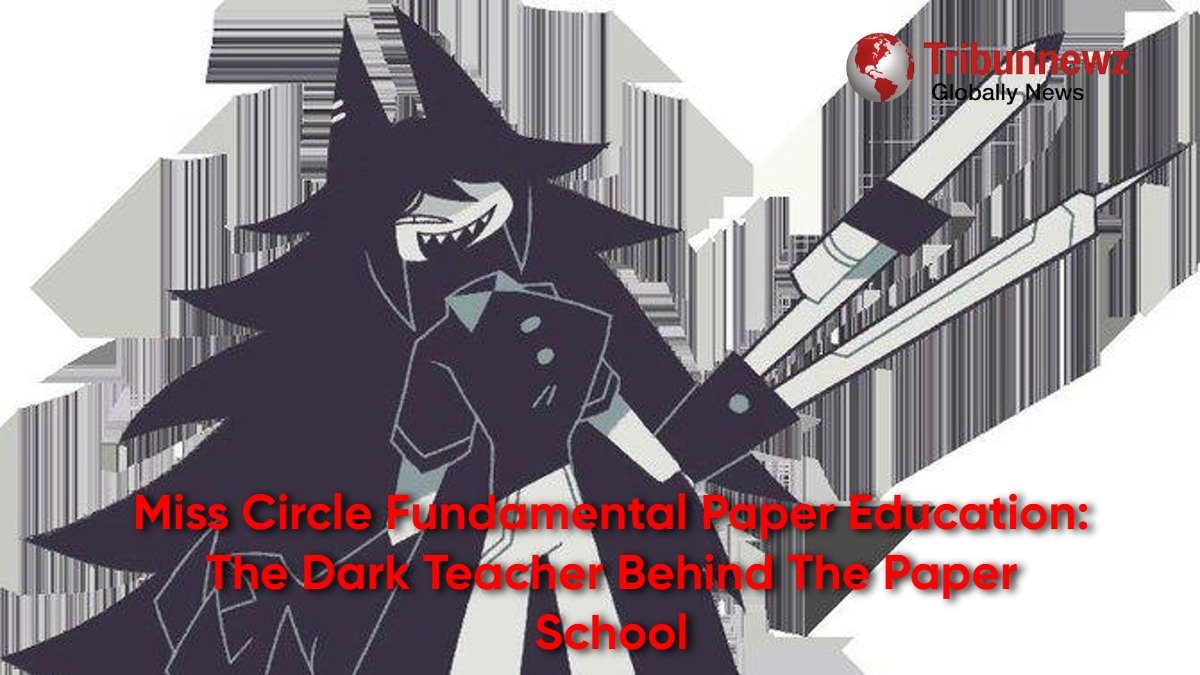
Miss Circle was introduced as the main antagonist in the short online animation Basics in Behavior, a non-canonical extension of the Fundamental Paper Education project created by Kaaatie. The character’s original design presents her as a towering math teacher — 9 feet 7 inches tall, capable of changing her height at will. The most remarkable physical characteristic of the actress is that she has a compass-shaped arm, which represents not only her mathematical accuracy but also her strictness used as a tool of self-defense. The voice she uses, which is produced through the Google Translate Japanese Text-to-Speech system in a haunting manner, lends the character an alien and mechanical quality that reinforces her disturbing nature.
What makes her story intriguing is that Miss Circle was never intended to be purely evil. Instead, she occupies a gray moral space — a “Near Pure Evil” archetype who blends horror with comedic absurdity.
The Classroom of Fear: Inside the Paper School
Set in Paper School, Miss Circle’s math class operates under an iron-fisted philosophy — “Learn or be punished.” Her tests are not tolerated patiently or with help; rather, the students who do not pass experience harsh consequences.
The educator’s motives seem to be unselfish to an extent: to assist the students in acquiring knowledge and sharpening their skills.
However, her methods cross every conceivable ethical boundary. She consumes and tortures children who fail, turning education into a battlefield of survival.
She often collaborates with fellow teachers Miss Bloomie and Miss Thavel, two figures who both aid and fear her. Harmony can act as a psychological and physical punishment system, being masked as discipline.
Psychological Profile of Miss Circle
From a character analysis standpoint, Miss Circle represents a psychopathic disciplinarian — a fictional trope combining intellect with sadism. Her personality embodies control, fear, and perfectionism pushed to horrifying extremes.
Her powers and skills include:
- High intelligence
- Peak-human strength, speed, and agility
- Ability to intimidate
- Compass arm for precision attacks
These traits aren’t just supernatural embellishments; they symbolize her desire for mathematical order — where every mistake must be corrected, even if through violence.
Interestingly, her love for Oreos — a recurring comedic motif — adds unsettling humor. It humanizes her, only to contrast her monstrous actions. The image of a smiling teacher munching on cookies before punishing a student adds to her ironic charm.
Anecdote: The Lesson That Turned Deadly
One of the most disturbing moments in her story involves Abbie, a student who fails a math test. Instead of giving him another chance, Miss Circle chases him through the halls, cornering and brutally killing him.
When another student, Lana, discovers the crime, she too is murdered offscreen. Later, her decapitated body is seen — a haunting reminder of the dangers of failure under Miss Circle’s rule.
Her violent outbursts serve as dark metaphors for the pressures of academic systems that value results over growth. In this twisted parody of education, failure literally equals death.
Near Pure Evil: What Makes Miss Circle Almost Irredeemable
According to the Villains Wiki classification system, Miss Circle fits the “Near Pure Evil” category. Characters under this label exhibit extreme cruelty while maintaining a trace of humanity or comedic absurdity.
What Makes Her Close to Pure Evil
- Cold-blooded murders of students Abbie and Lana
- Attempted murder of Claire, a new student unfamiliar with the school’s dangers
- Psychological abuse of students and staff
- Desecration of corpses and false imprisonment
- Hypocrisy in blaming others, such as Oliver and Zip, for consequences she caused herself.
Despite occasional humor — like T-posing through hallways or making cat faces, her violence remains unfunny within the story’s logic.
Her interactions with Mister Compass, rumored to be her lover or best friend, also reveal emotional detachment. Their arguments over snacks highlight her inability to form real human connections.
What Prevents Her From Being Pure Evil
While undeniably monstrous, Miss Circle lacks complete omnipotence or absolute malevolence. Several factors prevent her from achieving the status of “pure evil”:
- Ambiguity in her kill count – Only Abbie and Lana are confirmed victims, while others remain speculative.
- Unclear hierarchy – It’s uncertain if she leads the killer teachers or is just another participant.
- Comedic framing – Her exaggerated actions and absurd tone in the story maintain a satirical layer that dilutes pure horror.
This blend of humor and horror is what defines her as a “Silly Near Pure Evil” figure — frightening but not entirely beyond redemption.
Symbolism of Miss Circle’s Character
Symbolically, Miss Circle represents the dark side of education — the idea that strict discipline and fear-based motivation can destroy the spirit of learning. Her compass arm serves as a metaphor for mathematical precision turned into violence.
She embodies a question that resonates beyond fiction: What happens when education becomes obsession?
Her story also critiques how academic pressure and authoritarian teaching can cause emotional trauma in real life. The exaggerated violence in her character mirrors the anxiety students face in high-pressure learning environments.
Relationships and Hypocrisy Among the Teachers
Miss Circle’s alliances are fragile and manipulative. She collaborates with Miss Bloomie and Miss Thavel, yet shows no real care for them. They function more as tools in her system than genuine friends.
Likewise, she accuses the teachers of having lost their morality, but her behavior is actually more scandalous. It is this very hypocrisy that makes her portrayal as a villain difficult, since the villain knows the evil but continues to do so.
Trivia and Behind-the-Scenes Insights
- Basics in Behavior was a video that provided a non-canonical introduction to Fundamental Paper Education in a very creative way.
- The full web series was cancelled after creator Kaaatie experienced stress during production.
- Miss Circle’s height and weaponized arm were inspired by visual exaggerations often found in anime villains.
- Her text-to-speech voice became a viral meme in online horror communities.
- Had the series been released, it’s unknown whether her Near Pure Evil ranking would remain or evolve.
The Legacy of Miss Circle in Fan Culture
Even after the cancellation of Fundamental Paper Education, Miss Circle continues to inspire fan art, YouTube analyses, and creepypasta adaptations. Her blend of comedy, horror, and tragedy makes her a symbol of misunderstood authority figures.
Many fans interpret her story as an allegory of educational trauma — where good intentions, when corrupted by obsession, lead to horror. Her exaggerated personality invites both laughter and fear, creating an enduring online mythos.
Step-by-Step Breakdown: How Miss Circle’s Story Reflects Real-World Lessons
- Obsession with Perfection: Miss Circle’s need for perfect outcomes displays the perils of academic perfectionism.
- Loss of Empathy: Her lack of feeling reveals the consequence when instructors put regulations above people.
- Cycle of Fear: The terror of the learners mirrors the actual anxiety in the class caused by extremely strict policies.
- False Redemption: Despite moments of kindness, her core cruelty remains — teaching that superficial niceness can mask deeper rot.
Through this exaggerated lens, Fundamental Paper Education becomes a dark satire of schooling itself.
Conclusion: Beyond the Classroom Walls
Miss Circle Fundamental Paper Education stands as a haunting parable of learning gone wrong. By merging psychological horror, black comedy, and metaphorical narrative, it is a reminder that teaching without feeling is cruel.
The character Miss Circle is untrue to life, but her teaching points remain — real education has to have love, tolerance, and bravery to take safe risks.