


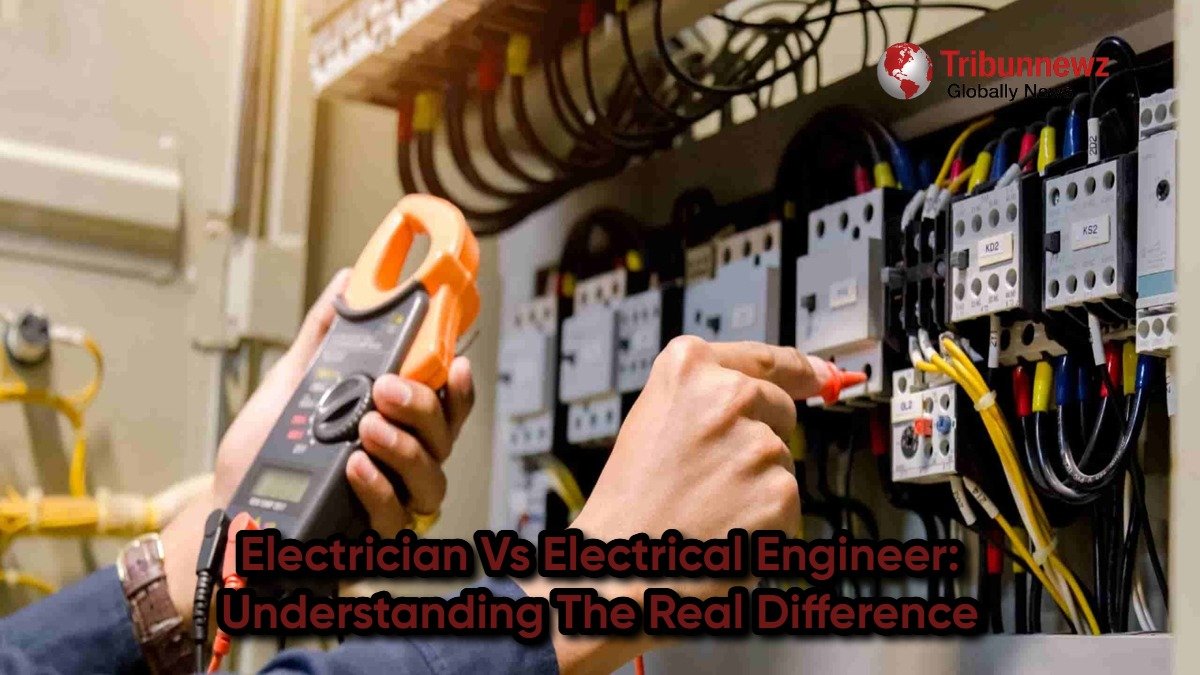
Choosing between an electrician and an electrical engineer may not be effortless because both careers are intimately connected with Electrician vs Electrical Engineer: Understanding the Real Difference and technology. However, they are still in the same sector, but their duties, education, and daily life are entirely different. Hence, this article has reduced the rivalry and has connected the two professions so that you can quickly point out which one suits your skills, ambitions, and conditions the most.
What an Electrician Actually Does
An electrician is a practical expert who works with electrical systems in various places such as households, offices, and factories. This professional directly deals with hardware such as wiring, circuit breakers, switchboards, and others that control the flow of electricity safely. Electricians mostly refer to the technical schematics made by engineers, which implies that every wire, socket, and joint is placed in accordance with safety regulations.
In the United Kingdom, electricians usually comply with the training regulated by the
City & Guilds or the
Electrotechnical Certification Scheme (ECS).
The course gives quite a lot of practice and a very good technical fault-finding skill that is like an engineer’s intuition. Electricians often mention the uncertain nature of their job, and in a way, it is their way of saying that their job is challenging and every day is different. One day, they could be in an attic of an old house, completely rewiring it, and the next d, ay they might be in a factory repairing machines. This kind of alternation makes the work of electricians very appealing, particularly for those who like to do hands-on problem-solving
What an Electrical Engineer Really Does
An electrical engineer, however, is the one who understands and designs level-up solutions in a more complex way. Furthermore, they participate in the entire process of system creation, testing, and updating of electrical systems ranging from microchips to power plants. In case an engineer is replaced by the electrical technician, then the latter would not be drawing the circuit diagrams, running computer-based simulations, or designing electrical products.
Electrical engineers, for the most part, have their degrees from the Institution of Engineering and Technology ( IET), which is their minimum requirement, and frequently employ very advanced tools and software like MATLAB, PSpice, or AutoCAD. The three areas from which these engineers take their knowledge are: Physics, Mathematics, and Creative Problem Solving.
The Path to Becoming an Electrician
In most cases, electricians are the ones who start with an apprenticeship, during which they attend school part-time and work on the site, receiving experience and wages at the same time. They learn the reg them GN 7671 Connexions For Application Networks.
This route is ideal for people who prefer practical learning and want to enter the workforce relatively early.
Education Required for Electrical Engineers
Electrical engineers need a more academically intensive path, typically completing a Bachelor’s degree in Electrical Engineering. University modules often include:
- Circuit analysis
- Electromagnetics
- Power systems
- Microelectronics
- Computer-aided design
Some engineers continue toward a Master’s degree or even a PhD, especially if they aim to work in research, automation, robotics, or renewable energy.
Universities monitored by the Engineering Council UK
ensure that degrees meet professional engineering standards.
A Day in the Life of an Electrician
Electricians start their day with job sheets, gathering tools, and going to different places. They spend most of their time figuring out the problems—finding out the cause of a malfunction and then doing it safely. They follow very strict and training-style safety measures as they work with live systems.
There’s also a real sense of impact. The very first thing that clearly and directly shows the outcome of an electrician’s work is either the customer perceiving that the electricity has been restored to his house or the elimination of a hazardous wiring problem.
A Day in The Life of An Electrical Engineer
The daily activities of an electrical engineer are primarily made up of planning. Simulations may be done, design discussions are held, models are made, or testing of the equipment in the laboratory occurs. Engineers participate in installations only in rare situations; otherwise, they do the designing of systems that are subsequently built by the electricians.
For example, an engineer might design the full layout of a building’s power supply. After a few weeks, the electricians come in and turn that plan into reality. Even though engineers mostly do their job in the office or lab, their choice impacts huge structures, urban areas, and sometimes even whole sectors.
Electrician Career Path
A Day in The Life of An Electrical Engineer
- Approved Electrician
- Master Electrician
- Electrical Inspector
- Site Supervisor
- Self-employed contractor
The vast majority of electricians would take the step to become their own bosses, thus securing financial independence and deciding when they work. A few others would concentrate on such specialties as photovoltaic installations, e.g., the solar power area, automation, or even power line constructions.
Electrical Engineer Career Growth
Electrical engineers
- Power systems engineering
- Telecommunication Engineering
- Automation and robotics
- Electronics product design
- Project management
A senior engineer might orchestrate various engineering teams, oversee projects worth millions, or even become the executive of the tech company if he takes the next step in his career.
The Impact on Society: Both Roles are Important
The work of electricians guarantees that the electrical supply in the most basic places, such as houses, schools, hospitals, and factories, is safe and uninterrupted. If there were no electricians, the installation of even the most high-end electrical systems would still be nothing but a project on paper.
On the other hand, electrical engineers are the ones who really draw the future of technology through their inventions. They are the very people behind the solar power, hybrids, wireless gadgets, and electricity grids that keep the country alive.
They are the foundation on which modern society will stand.
Career Choice?
The decision to become an electrician or an electrical engineer ultimately depends on the personal traits you possess.
- If you are a hands-on-type person who wants to handle things at their core and cannot wait to see the results of his/her work, then go for the electrician.
- If, conversely, you get fascinated by the thought of dealing with numbers and technology while being involved in the designing, analyzing, and constructing of very complex systems, then take the electrical engineer route.
The two professions always offer great job security, attractive salaries, and a chance to learn for life.
Conclusion
In the battle of electrician vs electrical engineer, the crucial distinction is found in the different ways the two professionals deal with electrical systems. Electricians deal with the physical aspect, where they install and maintain the wiring, while, on the other hand, electrical engineers are involved in the drawing and development of the technologies that are behind the systems. The two paths are really important to society, and the one that you will choose to walk depends on the things you are interested in, your personality, and your long-term goals.
If you are a person who loves to engage in creative problem-solving, technical drawing, and looking for a better way, then engineering may be your profession. On the other hand, if you are a hands-on worker who likes to have different things to do every day, then you should consider being an electrician.