


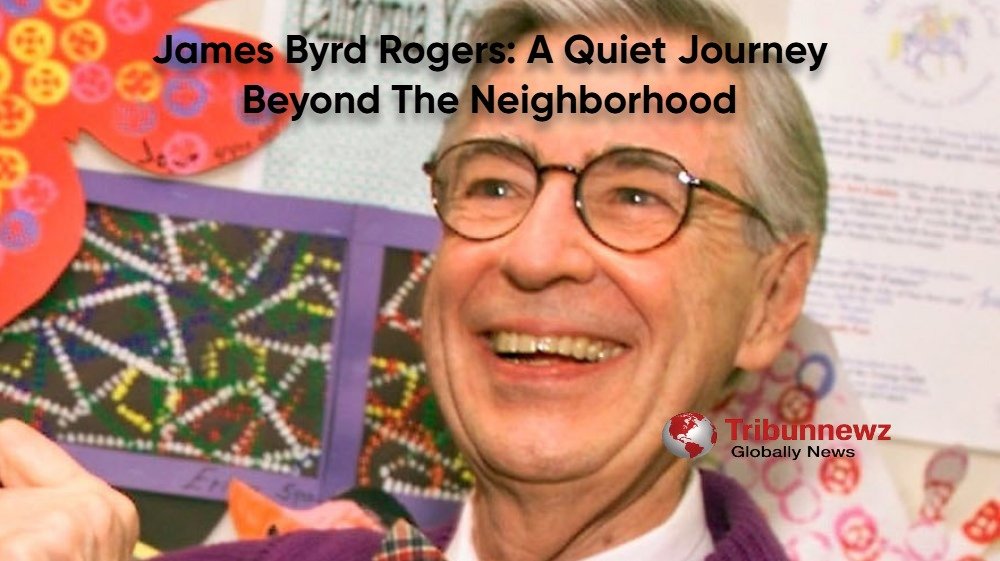
When the name Fred Rogers comes to mind, the majority of folks will depict the soft, cardigan-clad presenter of the darling kids’ program Mister Rogers’ Neighborhood. However, the man who was the public figure had a family behind, and his firstborn son, James Byrd Rogers, got to part of his life in the silent shade of the legacy. This article intends to take one through the tale of James Byrd Rogers, looking into his childhood, his quest for self-discovery, his bond with his father, and how he carved his way out. We’ll also look at lessons we can draw—step by step—for anyone growing up under big expectations or family legacy.
James Byrd Rogers was born in 1959 to Fred Rogers and his wife, Joanne Rogers. Tuko.co.ke – Kenya news.+2Rollins Library+2 His younger brother, John, followed in 1961. Growing up, James had a front-row seat to his father’s work on television—but he also had to navigate what it meant to be “the son of Mister Rogers.”
His mother, Joanne—herself a trained concert pianist—helped create a home filled with music, creativity, and kindness. Wikipedia+1 From the beginning, the Rogers household was one where values such as empathy, respect, and humility were more than just on-screen messages—they were personal.
And yet, even with all that love and good intention, living in the public shadow carries unique pressures. As one piece noted:
“Growing up, James Byrd Rogers experienced the stark contrast between the private life he knew at home and the public persona of his father.” Grunge+1
Family Legacy: Being the Son of Fred Rogers
Because Fred Rogers had become a cultural icon, James Byrd Rogers didn’t just grow up in any family—he grew up in that family. The one whose father’s voice, sweat, ers, and orderly pace were known in homes across the country. For many children, seeing that familiar figure every day brought comfort. For James, it meant navigating something more complex.
One anecdote captures this tension: At college, James stopped writing his parents or returning their calls — a decision that underscored his need for space. His father acknowledged it:
“It’s been painful, and it’s rough on Jamie … but if we don’t allow him to go off and have this time for himself, he’ll never come back to the nest.” Tuko.co.ke – Noticias de Kenia.+1
This moment highlights an important step: giving children—not just a legacy, but also the chance to step away and become themselves.
Step-by-Step: Finding Identity Outside the Spotlight
Here’s a practical, step-by-step reflection on how someone like James Byrd Rogers could, and in some ways did, carve out a personal sense of self beyond the weight of expectations:
- Recognize the legacy. First, accept that you come from something bigger than just you. James knew his father’s work and the environment he came from.
- Take space when needed. For James, that meant distancing himself—leaving home, not answering calls—for a period. That discomfort was part of growth.
- Return on your terms. He didn’t stay away forever; later, he reconciled and re-engaged. The key: returning when you’re ready, not when expected.
- Define your path. Instead of following the exact footsteps of his father’s career, James chose a more private life. It was his way of honoring the legacy and honoring himself.
- Live the values quietly. Even without public fanfare, the principles of kindness, humility, and integrity remained. In numerous respects, the less noisy route of James is a tribute.
This incremental manual is not only concerning James; it is about every individual who has to grow up under great expectations and finds it necessary to trace their own line.
Trials & Growth: Struggles in Early Adulthood
The journey wasn’t easy. According to reports, James Byrd Rogers rebelled against the high moral standard his father represented:
“It was difficult to have the second Christ as your dad,” his brother John later reflected. Grunge
Yet in the pain of that phase, growth can happen. The early adulthood of James was full of chaos, os but it not only showed a universal t, truth but also that it was the source of maturity, such as identity, expectation, a nd freedom he is dealing with.
A case in point would be where the majority of the public might derive their assurance from endless acceptance, James instead went for the authenticity route—even if it would bring along some disliking or separation. On the other hand, he received tranquility and self-approval.
Later Life: A Private Life with a Quiet Impact
Unlike his father’s very public path, James Byrd Rogers stepped into a more private mode. He made fewer public appearances, chose less visible roles, and avoided the spotlight. Tuko.co.ke – Noticias de Kenia.+1
The life of the individual in question confirms the notion that legacy is not necessarily about being in the spotlight, ht but rather it can consist of attributes like consistency, integrity, and silenced testimony.
We have the following information about his latter part of his life:
- He appeared on his father’s show a handful of times as a child. Grunge+1
- After that, he was mostly hidden from the public. Tuko.co.ke – Kenya news..
- He accepted the principles his dad imparted—yet in his own way..
This highlights a strong statement: there is no need to walk like the other one to pay respect to one’s legacy.
Takeaways for Us: What We Can Take from the Case of James Byrd Rogers
What does James’s story teach us? Here are some points we can each apply:
- Your background might be a tough challenge for you, but it is perfectly fine. Even someone iconic has children who wrestle with their identity.
- You don’t have to perform the legacy exactly—it can live through you in your own way. Instead of becoming a children’s TV star, James went for a less publicized and quieter option.
- One must experience the challenges of growth. It wasn’t that he abandoned his family to outshine them, as he had to do this to be himself.
- Values matter more than visibility. Living humbly and kindheartedly, yet real, is as important as eminent ones.
- Come back whenever you want, not when the others decide. Reconciliation and integration happen under your terms, not someone else’s schedule.
Conclusion: The Man Beyond the Name
Eventually, James Byrd Rogers may not be recognized by ma,ny, but his story is still very influential in a quiet way. It casts a light on the fact that living up to someone real big does not limit our way—it just gives us a place to start. And how we decide to move from there, either on the stage or out of the limelight, is up to us.
If ever you feel heavy-laden by expectation or background, think of James’s saga: he retreated, he discovered, he came back—not to a stranger’s tale—but to his own. And in this, he paid tribute to the ideals of love, service, and self-respect that his father preached, while at the same time, creating a life that was genuinely his.